
Restoring Masterpieces with AI: How Tech is Saving Van Gogh
The vibrant swirls of Van Gogh's "Starry Night," the contemplative gaze of Rembrandt's self-portraits, the dramatic chiaroscuro of Caravaggio – these masterpieces have captivated humanity for centuries. Yet, time is an unforgiving critic, and even the greatest works of art suffer from its relentless march. Fading pigments, cracking canvases, and accumulated grime threaten to obscure the genius within. But what if technology could turn back the clock?
Enter the fascinating world where artificial intelligence meets art restoration. This isn't about replacing human conservators, but empowering them with tools that were once the stuff of science fiction. Imagine a world where we can virtually peel back layers of damage, revealing the artist's original intent with unprecedented accuracy.
The Silent Erosion: Why Masterpieces Need Our Help
Before we dive into the AI magic, it's crucial to understand the challenges facing art preservation. Environmental factors like light, humidity, and temperature fluctuations take a toll. Accidents happen – a dropped canvas, an errant brushstroke from a previous, less careful restoration. And then there's the sheer age of these works. Pigments naturally degrade, canvases become brittle, and varnishes yellow and crack, obscuring details and altering colors.
Traditional restoration is a meticulous, slow, and often irreversible process. Conservators use microscopes, tiny scalpels, and specialized solvents, working with immense care to clean, repair, and stabilize artworks. It's a blend of science, art, and detective work, but it's limited by human perception and the physical constraints of the materials.
AI to the Rescue: A New Era of Restoration
This is where AI steps onto the canvas, offering a powerful new set of brushes. Machine learning algorithms can analyze vast datasets of art, learning patterns, brushstrokes, and color palettes specific to individual artists and periods.
Here's how AI is revolutionizing the field:
-
Virtual Cleaning and Inpainting: Imagine a painting covered in centuries of dirt and discolored varnish. AI can be trained to "see through" these layers, digitally removing them to reveal the original colors and details without touching the physical artwork. It can also "inpaint" missing sections, intelligently reconstructing them based on surrounding patterns and the artist's style. This allows conservators to experiment with different restoration approaches virtually before committing to any physical intervention.
-
Crackle Detection and Repair: The intricate network of cracks on old paintings, known as craquelure, is a natural part of aging but can obscure imagery. AI can precisely map these cracks, helping conservators understand the structural integrity of the artwork and identify areas that need stabilization. Advanced algorithms can even generate plausible "fill-ins" for missing paint within these cracks.
-
Authenticity Verification: AI can assist in distinguishing authentic works from fakes by analyzing minute details of brushwork, pigment composition (from spectral analysis), and even the underlying structure of the canvas. This helps museums and collectors make informed decisions.
-
Reconstructing Lost Art: Perhaps one of the most exciting applications is the ability to virtually reconstruct fragments of severely damaged or incomplete artworks. By analyzing surviving pieces and historical records, AI can propose how a lost section might have appeared, offering invaluable insights into the artist's complete vision.
The Van Gogh Example: Bringing Back the Brilliance
Consider a Van Gogh painting, perhaps one of his vibrant landscapes, whose yellows have faded, or whose blues have dulled over time.
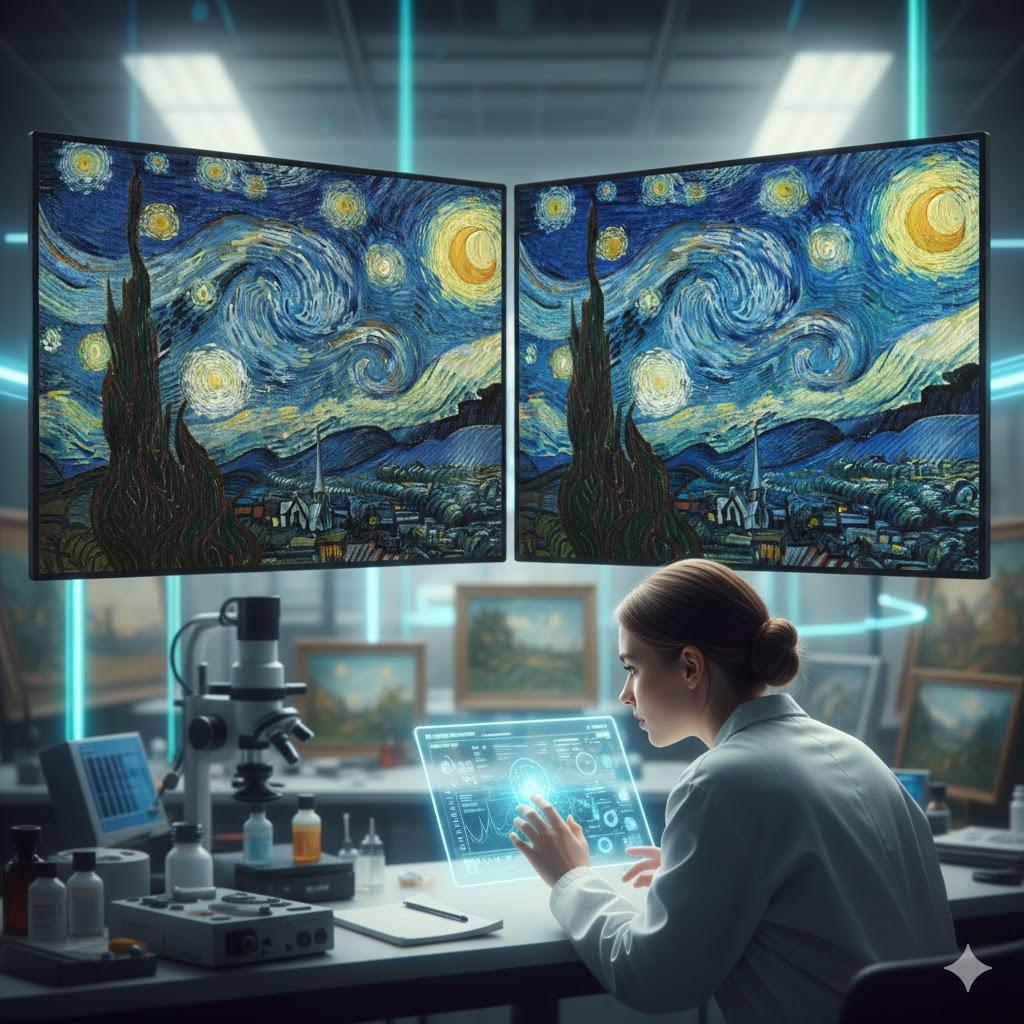
AI can be trained on high-resolution images of Van Gogh's work in its original, vibrant state (if such records exist) or by analyzing similar works from the same period. The algorithm can then compare these "ideal" states with the current, degraded version. It can identify the precise extent of color shift and fading, and then digitally "correct" these issues, presenting a virtual restoration that is remarkably close to the artist's original intention. This allows art historians to study the work as it was meant to be seen, and conservators to make more informed decisions about physical restoration, aiming for a result that respects the artist's vision while preserving the artwork's integrity.
The Future of Art and AI: Collaboration, Not Replacement
It's crucial to reiterate that AI isn't here to replace human expertise. Instead, it's a powerful collaborator. Conservators, art historians, and scientists will continue to be at the forefront of this work, using AI as an indispensable tool in their arsenal.
The integration of AI in art restoration promises a future where we can better understand, appreciate, and preserve our shared cultural heritage. It ensures that the masterpieces of yesterday can continue to inspire generations to come, their brilliance undimmed by the passage of time. As technology advances, so too does our ability to safeguard the very soul of human creativity.

 English (US)
 Arabic
 French
 Spanish
 Portuguese
 Deutsch
 Turkish
 Italiano
 Russian
 Romaian
 Portuguese (Brazil)
 Greek
Greek