
The Future of Work: Why AI Won't Replace You, But Someone Using AI Will
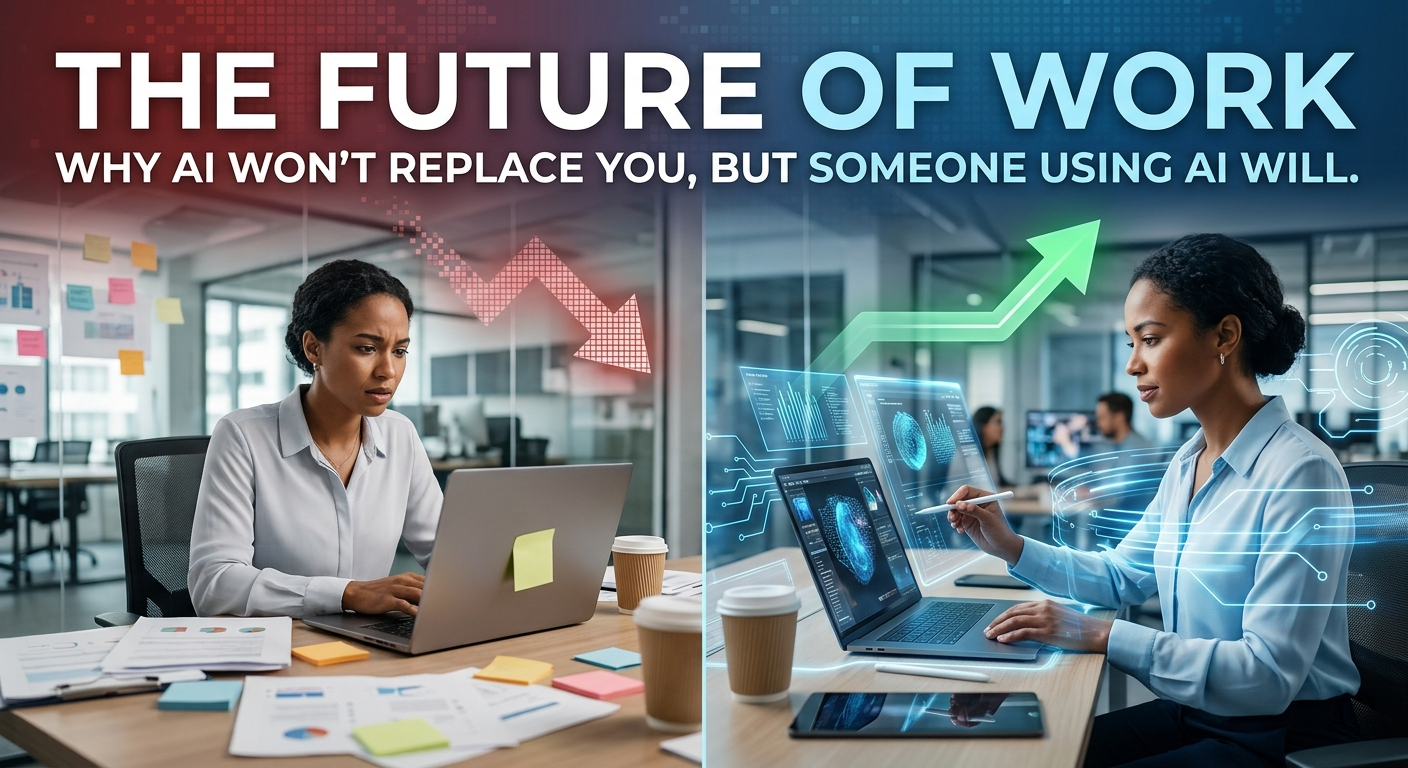
In the modern professional landscape, few topics ignite as much debate and anxiety as the rapid advance of Artificial Intelligence (AI). Will robots take my job? This question lingers in the minds of many. However, the emerging consensus among experts isn't that AI will cause mass unemployment, but rather that it will fundamentally reshape the skills required to succeed. The mantra for the future of work is not "AI vs. Human," but "Human + AI vs. Human alone."
AI is incredibly proficient at specific tasks. It can analyze vast datasets in seconds, generate lines of code, draft emails, and even create art. These capabilities often surpass human efficiency in repetitive or data-heavy domains. This leads to the automation of mundane tasks, which some interpret as a direct threat to employment. If a machine can write a basic report, what happens to the junior analyst?
The answer lies in understanding the difference between tasks and jobs. A job is a collection of tasks. While AI may automate individual tasks, most jobs require a combination of skills that AI cannot easily replicate. These include high-level critical thinking, complex problem-solving, emotional intelligence, creativity, and nuanced communication. An AI can generate a marketing slogan, but it cannot understand the cultural subtleties of a target audience or build a long-term brand strategy.
The real shift occurring is the creation of a two-tier workforce. On one side are professionals who view AI as a threat and resist integrating it into their workflows. On the other side are those who view AI as a powerful tool to enhance their productivity, creativity, and strategic capabilities. The latter group doesn't just work faster; they work smarter, achieving results that were previously impossible for a single person.
Imagine two graphic designers. Designer A uses traditional methods. Designer B uses generative AI to instantly create dozens of concept variations, then uses their artistic judgment and creative vision to refine the best one. Designer B can produce more high-quality work, explore more creative directions, and spend more time on strategic client interaction. Who is a client more likely to hire? The answer is clear: the person who can harness technology to deliver superior results.
The key to future-proofing your career is to stop seeing AI as a replacement and start seeing it as an augmentation. Identify the parts of your job that AI can handle and delegate them. This frees up your time and mental energy to focus on the uniquely human aspects of your work—the parts that add the most value and cannot be automated. The future belongs not to the AI, but to the professional who knows how to wield it.

 Arabic
 French
 Spanish
 Portuguese
 Deutsch
 Turkish
 Dutch
Dutch
 Italiano
 Russian
 Romaian
 Portuguese (Brazil)
 Greek
Greek